
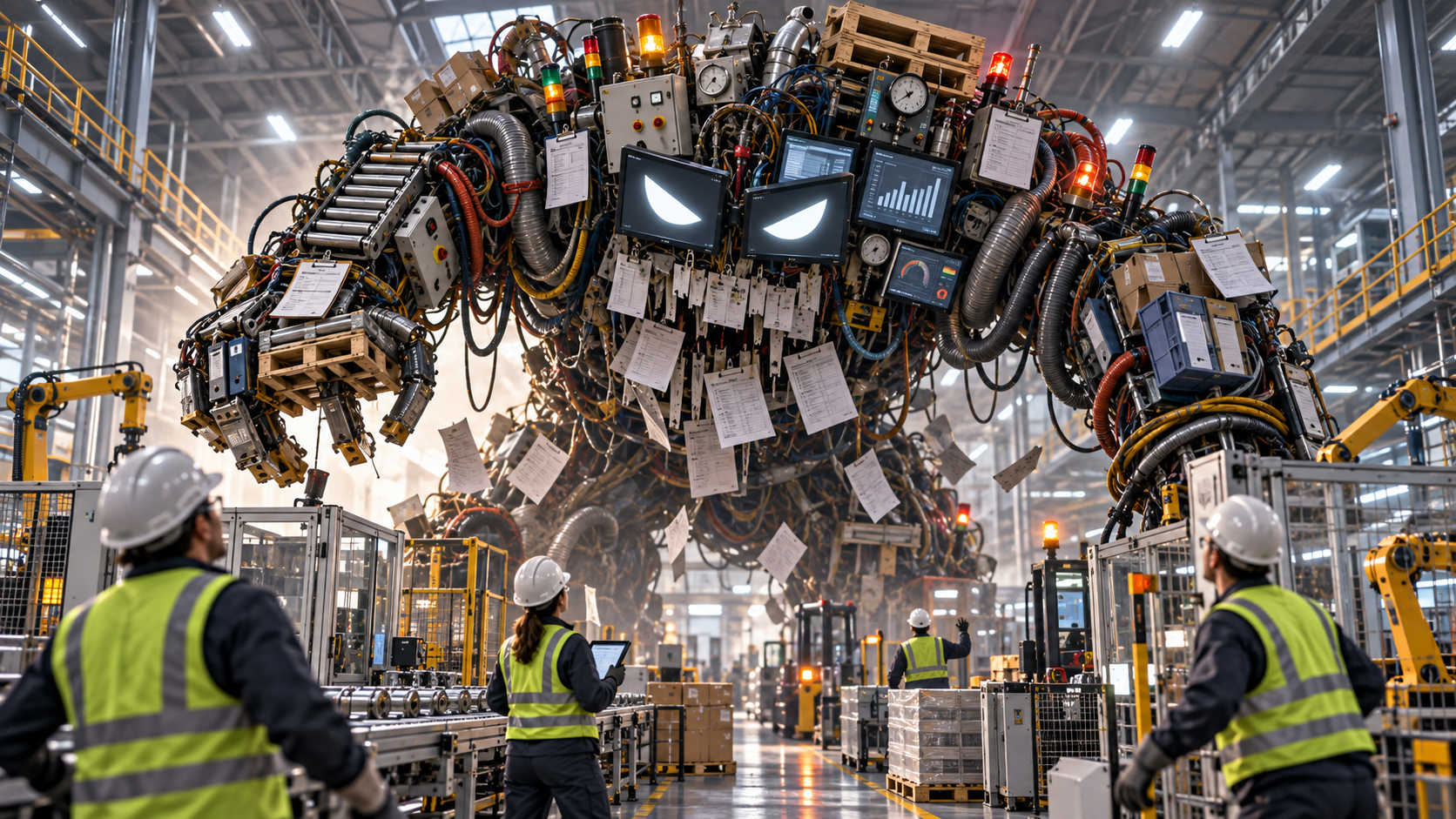
B2B has a politeness problem. Too many companies sound as though they were dressed by the same corporate stylist: sensible navy blazer, carefully neutral vocabulary, absolutely no intention of offending anyone. Everyone is innovative, customer-centric and transforming something, which is precisely why so little of it is memorable.
Strong stories usually have something working against them. In B2B, that does not mean attacking a competitor or inventing controversy. The more useful “monster” is often an entrenched belief, an accepted inefficiency or a way of working that everyone has simply learnt to tolerate.
Think of the Frankenstein workflow: five systems stitched together over a decade, none of them communicating properly, kept alive by one heroic operations manager and an Excel spreadsheet everyone is terrified to touch. Or the assumption that automation only makes sense at very large scale. Or the belief that the safest answer to constrained infrastructure is always to build more of it.
These are better villains because they aren’t companies. They are ideas.
And that leads to a more interesting communications question than “what problem does our product solve?”
What belief keeps the problem alive?
Give the problem a name
B2B campaigns often describe pain points accurately but forget to make them recognisable. “Legacy systems create complexity” is true, but forgettable. “Manual processes reduce efficiency” is also true, but unlikely to make anyone reconsider how they work.
A strong name gives the problem shape. “The pilot trap” immediately suggests technologies that never escape endless trials. “The capacity myth” challenges the assumption that adding infrastructure is always the first answer. “The manual reconciliation tax” reframes an inefficient process as a cost the organisation keeps paying.
The phrase itself is not the strategy. What matters is the argument behind it.
If a company can identify an assumption the industry has stopped questioning, explain why it no longer holds and support that view with real experience or evidence, it moves beyond simply describing what its product does. It starts to define what needs to change.
Do not rush to kill the monster
This is where B2B communications often gets the sequence wrong, leading with the solution before establishing the problem: "Our technology does this. Our platform improves that. Our service delivers a measurable percentage improvement."
But if the audience hasn't yet accepted that the current way of doing things is becoming untenable, the solution has little dramatic weight.
A stronger story spends more time examining why the old approach persists. What changed around it? What does continuing as before now cost? Why do customers still tolerate it? Where is the gap between industry habit and operational reality?
That is often where good thought leadership becomes useful. It gives a company permission to challenge an accepted idea before asking anyone to buy an alternative.
The monster, however, has to be real. It should emerge from customer conversations, technical experience, failed projects, or patterns the company has seen repeatedly. Invent one purely for attention, and it becomes a gimmick. Name something the market already feels but has not articulated, and it can become a powerful position.
Perhaps that is the real value of the monster. It gives the audience something to disagree with, recognise, or finally put a name to.
And in a B2B world full of very polite companies saying very sensible things, that may be exactly what makes a brand worth listening to.