
Climate's loudest week happened in its quietest year
The sector has never been better at bringing people together. The challenge is ensuring the conversation reaches far beyond the conference hall.
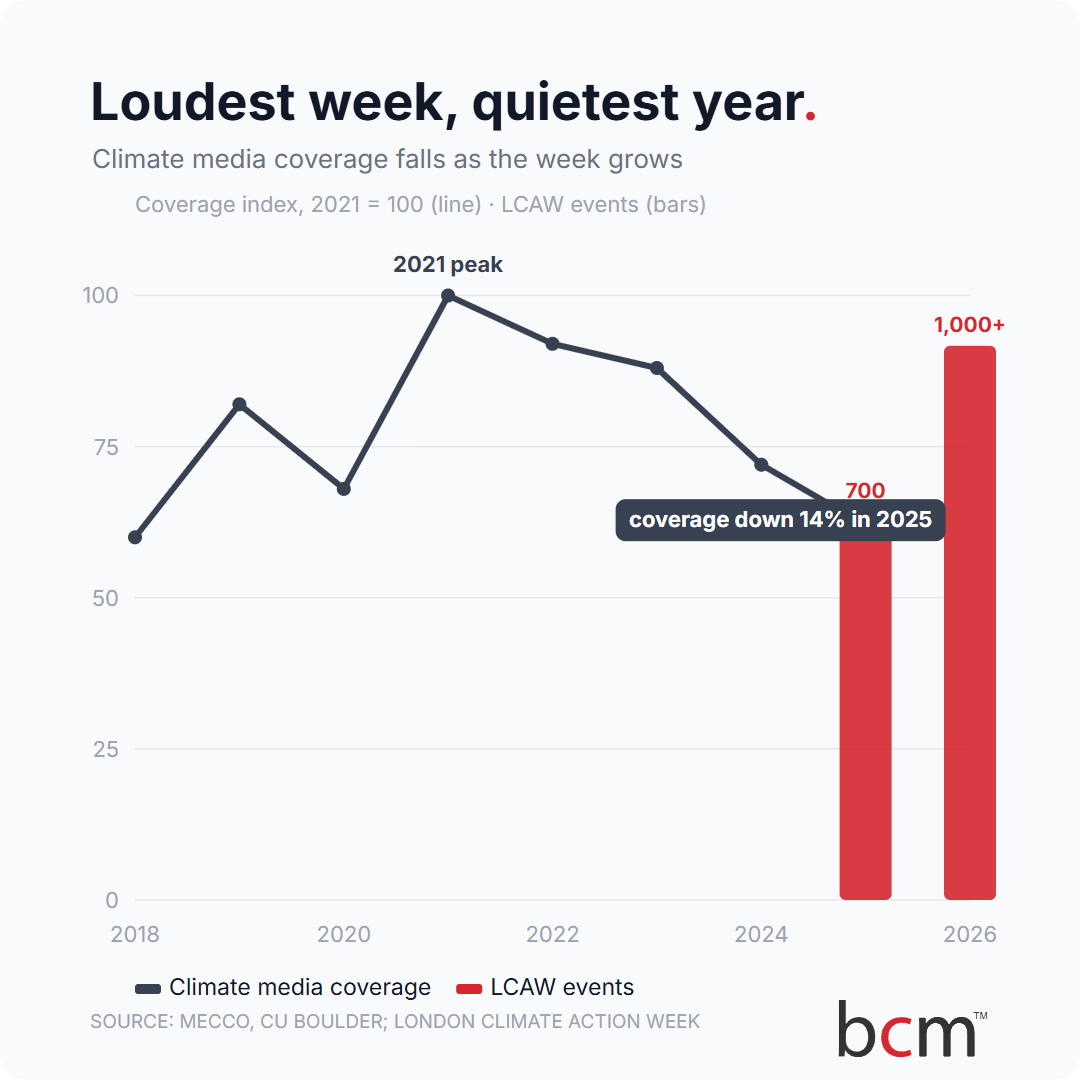
London Climate Action Week was the biggest it has ever been. By its organisers' own count, more than 1,000 events and more than 75,000 people across nine days, in a city that spent the week under a record June heatwave. Presidencies, ministers, financiers, scientists. The UN Secretary-General António Guterres caught the mood in a line quoted everywhere: “London isn't just calling, it's cooking.”
I read a great many of the reflections that followed. They were thoughtful and generous, and close to identical: the heatwave, the same quote from Guterres, the same reassuring shift “from ambition to delivery.” Here is what almost none of them mentioned. It is the thing the week actually opened on.
The week opened on a warning, not a victory lap
On day one, the Mayor of London opened LCAW not with a celebration of progress but with a warning about climate disinformation.
“When we talk about disinformation, we're not talking about well-intentioned attempts to challenge, criticise, or persuade. We're talking about deliberate and coordinated attempts to deceive with deadly consequences.”
Sir Sadiq Khan, Mayor of London, opening LCAW 2026
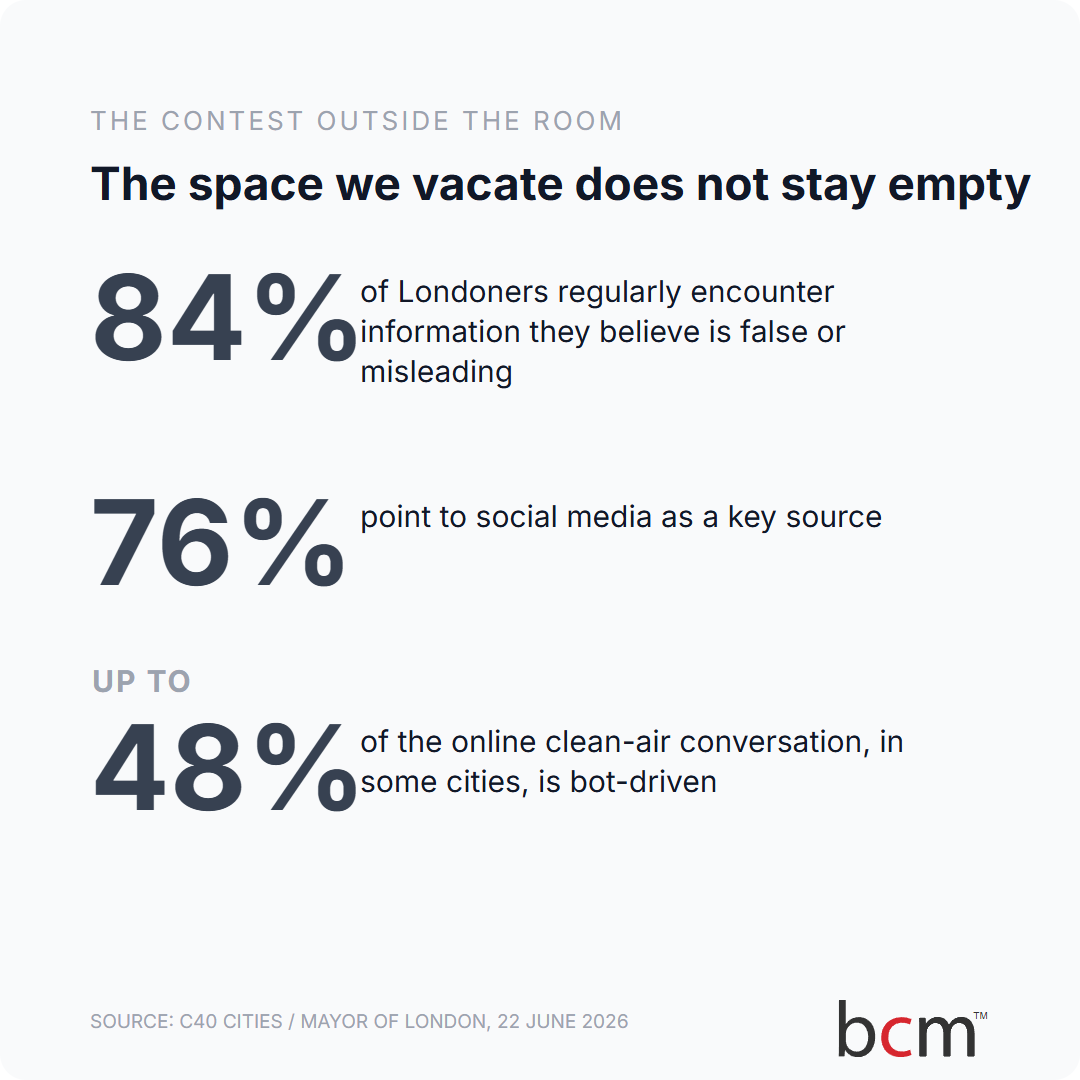
The data behind the warning is hard to look away from. In London, 84% of people say they regularly encounter information they believe is false or misleading, and 76% point to social media as a key source. In some cities, up to 48% of the online conversation about clean-air policy is driven by bots.
"Disinformation and misinformation do more than distort public debate. They delay action, weaken preparedness, and put lives and livelihoods at risk.”
Selwin Hart, UN Special Adviser on Climate Action and Just Transition
Now hold that against the wall of wrap-up posts. The week’s own host, E3G, put its message for the week plainly. In the words of its chief executive, Nick Mabey: “Don’t stop talking about climate.” When the organiser of the world’s largest independent climate event has to spell that out, something in the communication of climate is not working.
Inside the room, louder than ever. Outside it, quieter.
There is a paradox at the centre of this, and it is worth stating plainly. While attendance climbs, coverage falls. Global media coverage of climate dropped 14% in 2025, and now sits 38% below its 2021 peak, ranking tenth of the past 22 years tracked. This is not a blip. Professor Max Boykoff, who runs the observatory behind those numbers, is blunt about the cost:
“When the media fail to cover these pressing climate issues abundantly and accurately, people may not recognise how climate change shapes their daily lives, livelihoods and challenges.”
Professor Max Boykoff, Media and Climate Change Observatory, CU Boulder
And the evidence from LCAW itself made his point. The coverage that did break through was mostly about the temperature, not the transition. The heatwave made the news. Much of the work itself remained largely within specialist audiences.
The vacuum does not stay empty
A gap in the public conversation is not a neutral space, waiting politely for good information to return. It gets filled. And many credible voices are choosing to step back from it. South Pole's research found that the majority of companies across nine of fourteen major sectors are deliberately reducing their climate communications, even as most keep setting net zero targets. Its interim CEO, John Davis, named it precisely:
“A continuing and deepening contradiction between taking corporate climate but choosing not to communicate around it.”
John Davis, Interim CEO, South Pole
The behaviour even has a name now: greenhushing.
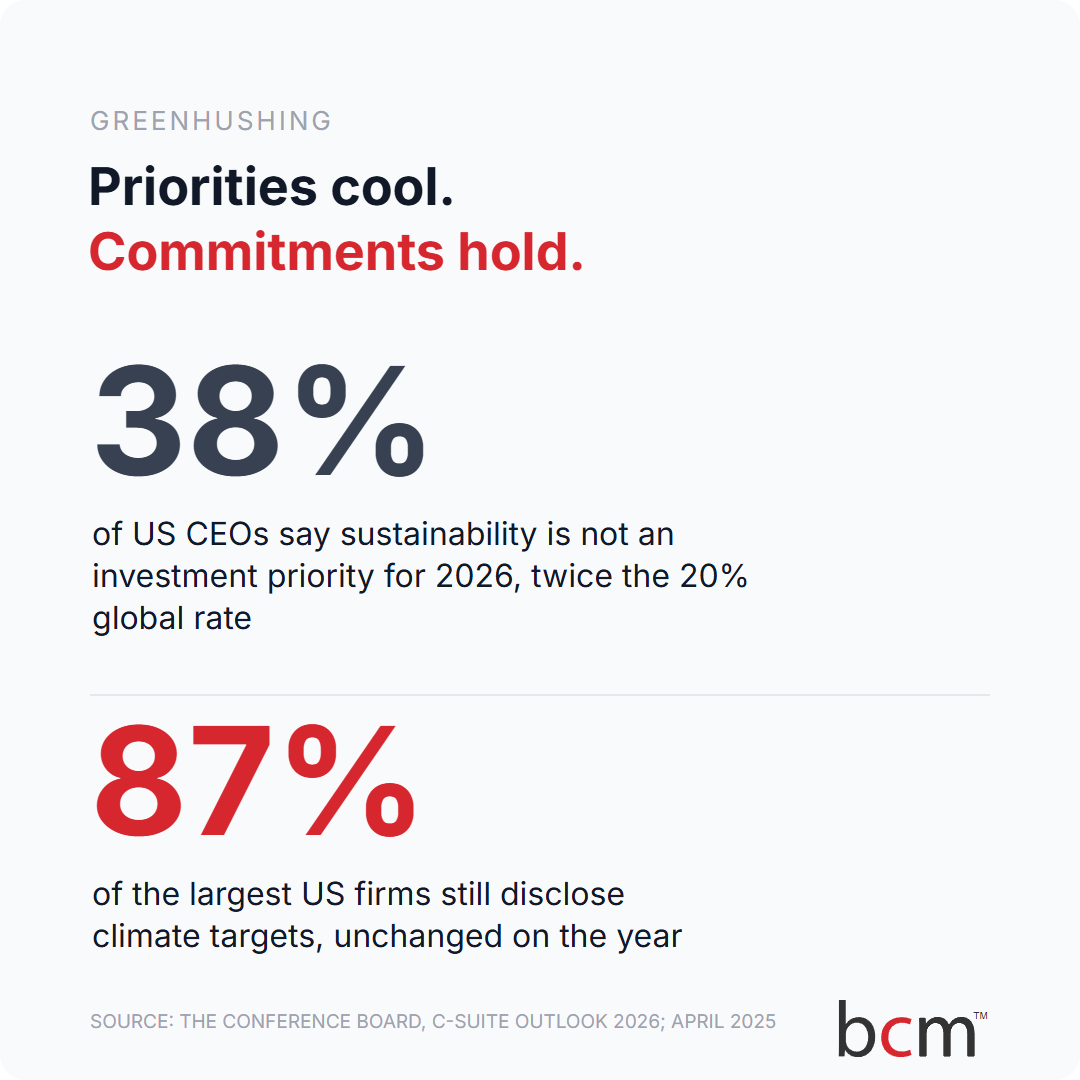
The retreat shows up in the numbers, not just the messaging. In the US, where the backlash is sharpest, the number of large companies publishing a sustainability report fell 17% in 2025, and 38% of chief executives now say sustainability is not an investment priority for 2026, twice the 20% recorded globally. Yet the underlying commitments are largely holding: 87% of the largest US firms are still disclosing climate targets, unchanged on the year. Companies are doing the work and, increasingly, saying less about it.
Put the pieces together and the picture is stark. Coverage is down. Companies are communicating less about their climate work. As they step back from the conversation, other voices, not all of them evidence-based, have greater opportunity to shape public understanding.
Why staying in the conversation matters
Senior international figures, including UN Secretary-General António Guterres, have repeatedly argued that climate communication has become a defining challenge of the transition. Whether discussing misinformation, public trust or the role of industry, the common thread is that the battle for public understanding is intensifying.
Whatever one’s view of the specifics, the common thread is a communications challenge. The public conversation around climate has become more contested, with competing narratives fighting for attention and trust. In that environment, withdrawing from the conversation does not remove the debate. It leaves less room for credible, evidence-based voices to shape public understanding.
It is not. Silence starves your customers, investors and partners of the proof they are actively asking for, and it hands the microphone to louder and less accurate commentary. The answer to the fear of being accused of greenwashing is not to stop communicating. It is to communicate better: specific, evidenced, honest about what is hard, and repeated often enough to be believed.
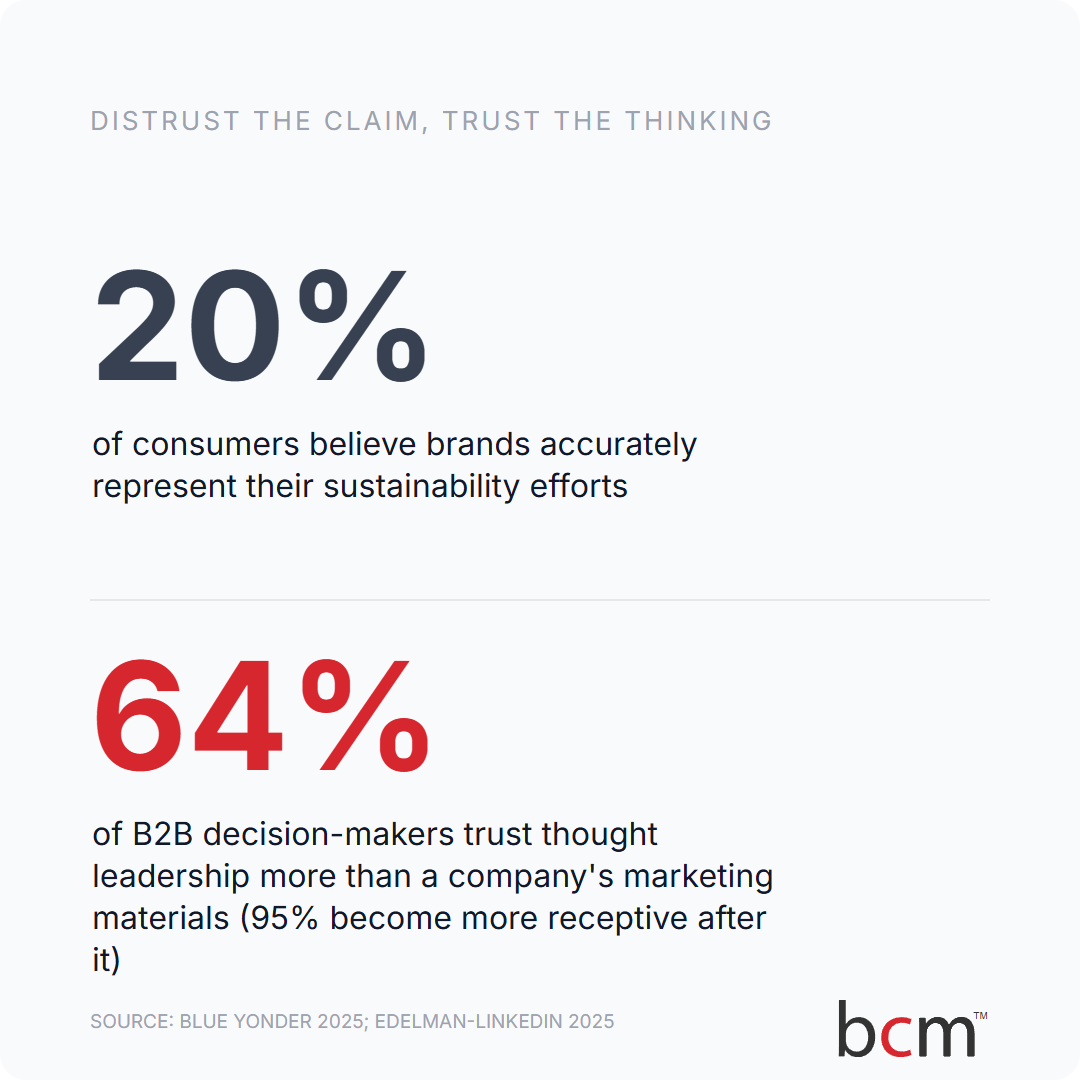
That is a commercial argument, not a soft one. Even in a low-trust market, where only around one in five consumers believes brands accurately represent their sustainability efforts, substantive thought leadership still moves the people who matter: 64% of business decision-makers say they trust it more than a company’s marketing materials, and 95% of the quieter, harder-to-reach influencers in a buying group become more receptive to a conversation after encountering it.
What “delivery” should mean next
The honest theme of this year’s London Climate Action Week was the move from ambition to delivery. If we mean it, communication has to count as part of delivery, not an afterthought to it. Show up where the argument is actually happening, not only in the rooms where everyone already agrees. Translate what happens inside those rooms for the people who were not in them. Keep talking through the backlash rather than going quiet because of it. And measure whether anyone outside your own industry actually heard you, because that, not attendance, is the real test of a week like this one.
London Climate Action Week proved again that the sector can fill a city. The harder and more urgent task is making sure the story leaves the building. Attention is not the same as being heard.
The organisations that build lasting trust over the next decade will not simply be those making progress. They will be those able to explain that progress clearly, credibly and consistently to audiences far beyond the conference hall.